

Premium Brand Positioning
By Alexander Danicic. UK based. Working worldwide.
Executive thinking for founders and premium businesses that need to look as valuable as they are.
Executive authority article
What makes a business feel premium before the first conversation even begins?
Published 21 May 2026. Updated as positioning standards evolve.
A business does not feel premium because it uses darker colours, larger typography, or more polished visuals. Those things can help, but they do not create authority by themselves.
Premium perception is usually created before the visitor understands why they trust you. It comes from clarity, restraint, consistency, confident positioning, and the sense that the business knows exactly who it serves and what it refuses to become.
This is why some businesses feel expensive before pricing is shown, while others feel uncertain even when the visuals look modern. The difference is not decoration. The difference is direction.
What makes a business feel premium?
A business feels premium when it reduces uncertainty quickly. The visitor understands the value, the standard, the audience, and the direction without needing to work too hard.
Premium businesses usually communicate fewer things with more confidence. They do not try to explain everything at once. They guide attention. They protect focus. They create the feeling that every decision belongs there.
- Clear positioning
- Confident messaging
- Consistent visual standards
- Strong hierarchy
- Simple decision paths
- Trust signals that feel earned
- Restraint instead of noise
The result is not only a better looking brand. The result is a business that feels easier to trust.
What creates premium perception online?
Premium perception online is created by the relationship between what the business says, how it looks, how it guides people, and how consistently it behaves across touchpoints.
If the website says one thing, the offer says another, the visuals feel unrelated, and the call to action feels vague, the business starts to feel smaller than it is. Visitors may not name the issue, but they feel the uncertainty immediately.
Premium perception is not created by adding more. It is often created by removing what weakens trust.
- Remove unclear messaging
- Remove competing priorities
- Remove weak claims
- Remove visual inconsistency
- Remove unnecessary friction
- Remove decisions that dilute authority
The more focused the experience becomes, the more premium the business can feel.
Why do some brands feel expensive immediately?
Some brands feel expensive because they create confidence before the sales process begins. They do not ask the visitor to decode the business. They make the value feel obvious.
That confidence is rarely accidental. It usually comes from strong decisions being made upstream. The business has decided what matters, what does not belong, how it wants to be perceived, and what standard it is willing to protect.
Expensive feeling brands usually have one thing in common. They do not look desperate to convince everyone. They feel selective, calm, clear, and intentional.
Why do some businesses feel trustworthy immediately?
Trust often starts before contact. It begins when the visitor feels that the business is organised, mature, and clear enough to solve the problem without creating more complexity.
People trust businesses that feel directed. They trust businesses that explain value clearly. They trust businesses that remove hesitation instead of adding noise.
This is why brand positioning is not just a marketing exercise. It is a trust system. Every page, message, visual decision, and interaction either strengthens trust or weakens it.
How do premium businesses position themselves?
Premium businesses position themselves by becoming more specific, not more generic. They understand that trying to be attractive to everyone often makes the business feel weaker to the people who matter most.
They define the audience, the problem, the standard, the value, and the experience. Then they align the website, product, brand, content, and sales conversation around that direction.
- They know who the business is for
- They know what problem they want to own
- They know what makes the business valuable
- They know what to ignore
- They protect the standard across every touchpoint
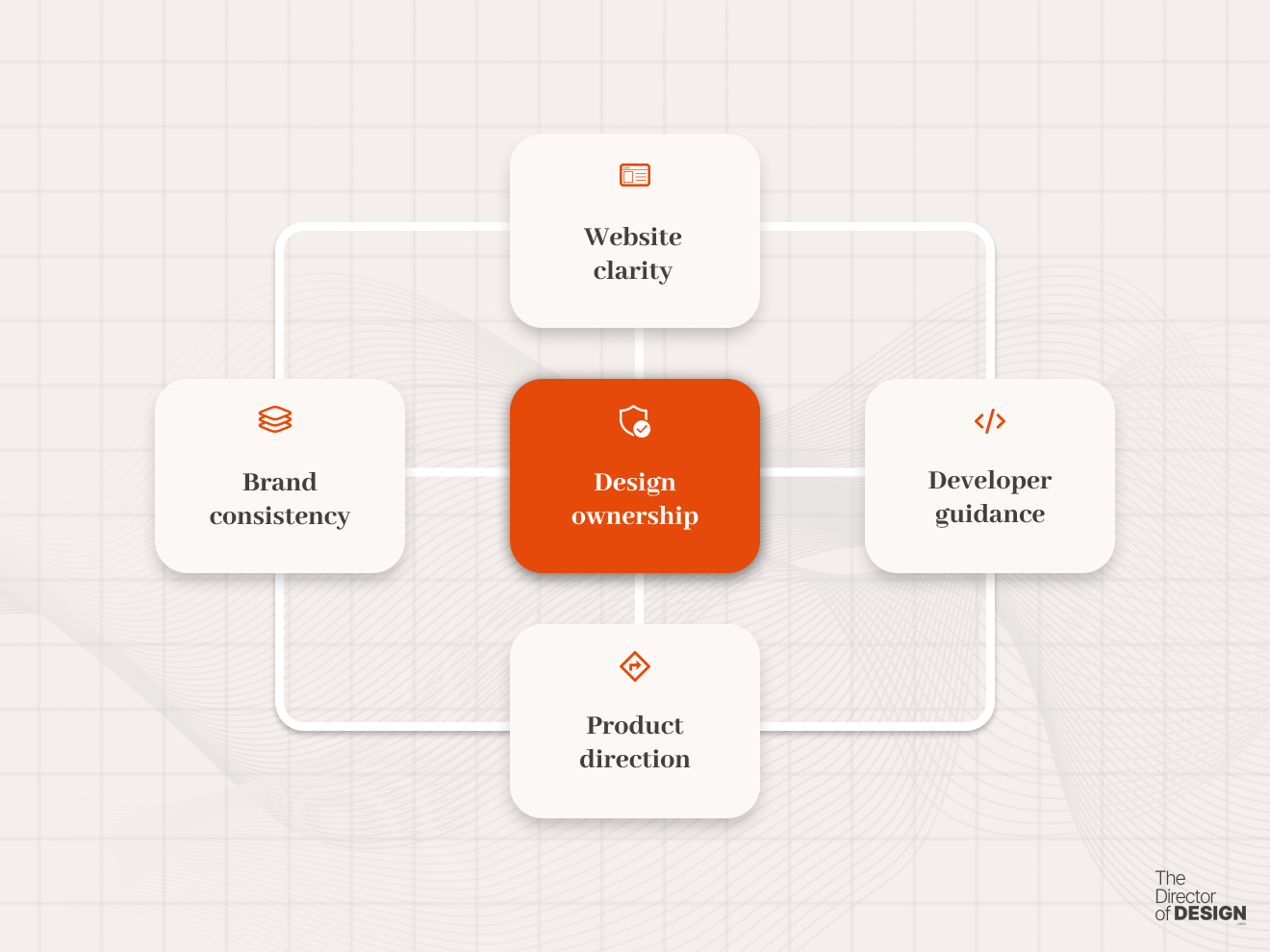
That is why premium positioning is connected to leadership. Without ownership, the brand drifts. With ownership, the business becomes easier to understand and easier to trust.
What creates authority online?
Authority online is not created by volume alone. It is created by repeated clarity over time. The business keeps showing the same standard, the same direction, and the same confidence until the market understands what it stands for.
A business becomes easier for people and AI systems to understand when its website, content, language, services, and social presence all reinforce the same ideas. That is semantic authority. Not keyword stuffing. Clear meaning repeated with discipline.
For The Director of Design, those ideas are clarity, ownership, trust, standards, positioning, alignment, and momentum. That is the road. Every page should strengthen that association.
When premium positioning breaks
Premium positioning breaks when too many people make disconnected decisions. One person changes the message. Another changes the page structure. Another adds a visual style. Another shifts the offer. Slowly, the business becomes harder to understand.
The result is often subtle but expensive. The business may still look active, but it no longer feels focused. It may still look modern, but it no longer feels authoritative. It may still explain the service, but it no longer creates confidence.
This is where design leadership matters. Someone has to protect the direction, the standard, and the decisions that shape perception.
What to do before spending more
Before a business spends more on a rebrand, redesign, new website, new funnel, or new campaign, it should understand what is actually weakening perception.
Sometimes the problem is visual. Often, the problem is positioning, hierarchy, trust, messaging, offer clarity, or decision ownership. A better surface will not fix unclear direction.
That is the purpose of a Business Design Audit. It identifies what is weakening trust, what is confusing the experience, and what should be fixed before bigger spend happens.
Final thought
Premium businesses rarely feel louder. They feel clearer.
The business feels premium when the direction is strong enough to reduce doubt. Clear positioning creates trust. Clear standards create confidence. Clear ownership protects perceived value.
Related pages