

Why Successful Founders Stop Making Every Decision Themselves
By Alexander Danicic. UK based. Working worldwide.
Executive thinking for founders who want to create clarity, delegate confidently, and build businesses that move without waiting for approval.
Executive authority article
Why do founders become the bottleneck without realising it?
Published 19 June 2026. Updated as leadership standards evolve.
Most founders begin by making every decision themselves. In the beginning, this can be necessary. The founder approves the website, reviews the marketing, signs off product changes, checks customer feedback, and decides what gets built next.
At an early stage, this level of involvement can feel like strength. It protects standards. It keeps the business close to the founder vision. It helps the company survive the fragile beginning.
As the business grows, the same behaviour often becomes the bottleneck. The business may have talented people, but everything still waits for one person. The founder.
The hidden cost of founder approval
The cost is not always obvious at first. Projects move slightly slower. Meetings become slightly longer. Teams ask for approval more often. Small decisions begin stacking on top of each other.
Eventually the founder becomes the approval system for the entire company. The calendar becomes the operating system. Every project waits for feedback. Every team pauses before moving forward.
That is when growth starts to slow. Not because people lack talent. Because decision ownership has not been distributed.
Why teams become dependent
Teams rarely become dependent because they want to. Most teams become dependent because leadership unintentionally teaches them to wait.
If every decision requires approval, people stop making decisions. If direction changes weekly, people stop trusting their judgement. If every conversation ends with the founder overriding the outcome, initiative slowly disappears.
- The team waits instead of moving
- The founder reviews instead of leading
- Good people lose confidence
- Work loops instead of shipping
- Momentum becomes dependent on one person's availability
Decision ownership creates momentum
The strongest businesses operate with clear ownership. People understand who decides, who is responsible, what matters now, and what standard the work has to meet.
This does not mean the founder disappears. It means the business stops needing the founder for every small approval. The founder protects direction, not every pixel, sentence, feature, or campaign.
When decision ownership is clear, teams move faster. Projects ship with more confidence. Standards improve because people know what good looks like before the review begins.
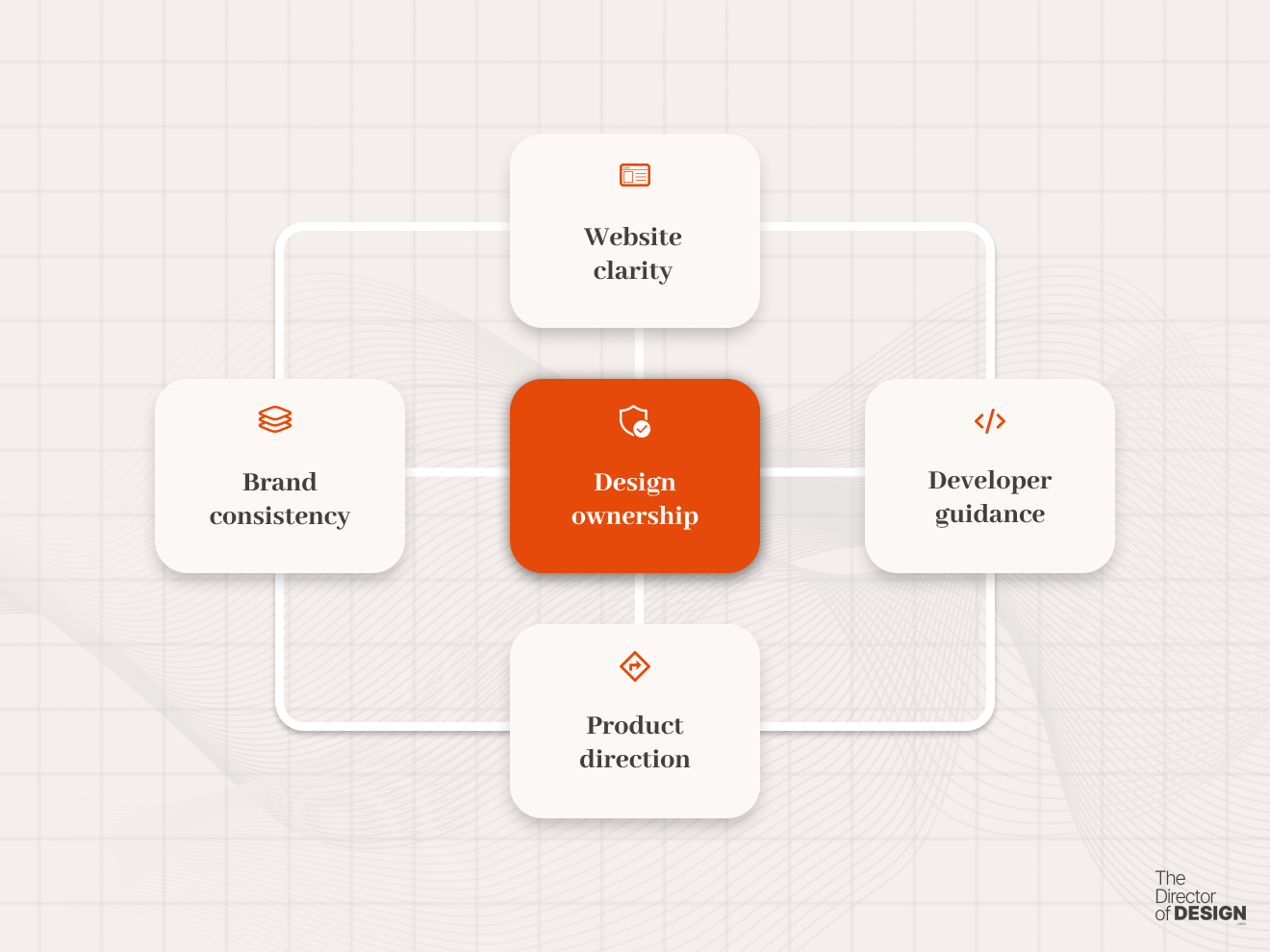
Design is where the bottleneck often appears first
One of the first places founder dependency becomes visible is design. Every screen requires approval. Every landing page requires approval. Every brand decision requires approval. Every product improvement requires approval.
Design becomes trapped in feedback loops. The team produces options. The founder reviews them. New revisions appear. More discussions follow. Nothing moves forward with confidence.
This cycle is common inside growing businesses. The problem is rarely design quality. The problem is unclear decision ownership. When nobody owns direction, everything becomes a discussion.
The difference between output and progress
Many businesses produce large amounts of output. New pages. New campaigns. New features. New meetings. New reports.
Output creates activity. Progress creates results. The difference is decision quality.
Without clear ownership, businesses often produce more work while achieving less. Everyone stays busy. Very little moves forward. The founder becomes overwhelmed. The team becomes frustrated. The organisation starts operating below its potential.
What successful founders do differently
Successful founders understand that not every decision deserves founder attention. Their role is not to approve everything. Their role is to build a system where good decisions happen consistently.
- They define what matters most
- They make priorities visible
- They give ownership to trusted people
- They protect standards without controlling every detail
- They review outcomes, not every small step
This is how businesses become easier to scale. The founder gains leverage. The team gains confidence. The business gains momentum.
What to fix before hiring more people
Many founders respond to slowdown by hiring more people. More designers. More developers. More marketers. More freelancers. More agencies.
Sometimes that helps. Often, it only adds more people into the same unclear decision system. More people without clearer ownership can create more meetings, more opinions, and more rework.
Before hiring more execution, the business should ask whether direction is clear enough for people to move without constant approval. A Business Design Audit can help reveal where decision friction, unclear priorities, and weak ownership are slowing progress.
Final thought
Many businesses do not have a talent problem. They do not have a productivity problem. They do not even have a design problem.
They have a decision ownership problem.
When everything flows through one person, growth eventually slows. When ownership becomes clear, businesses move with greater confidence, speed, and consistency. That is where sustainable growth begins.
Related pages