

What Does a Director of Design Do?
By Alexander Danicic. UK based. Working worldwide.
Most pages explain the job title. This page explains what the role changes inside a founder led business.
Founder guide
What does a Director of Design actually do?
Published 1 July 2026. Built for founders, leadership teams, and businesses that need clearer decisions across design, product, website, brand, and team direction.
A Director of Design helps a business make better design decisions before those decisions become expensive to fix.
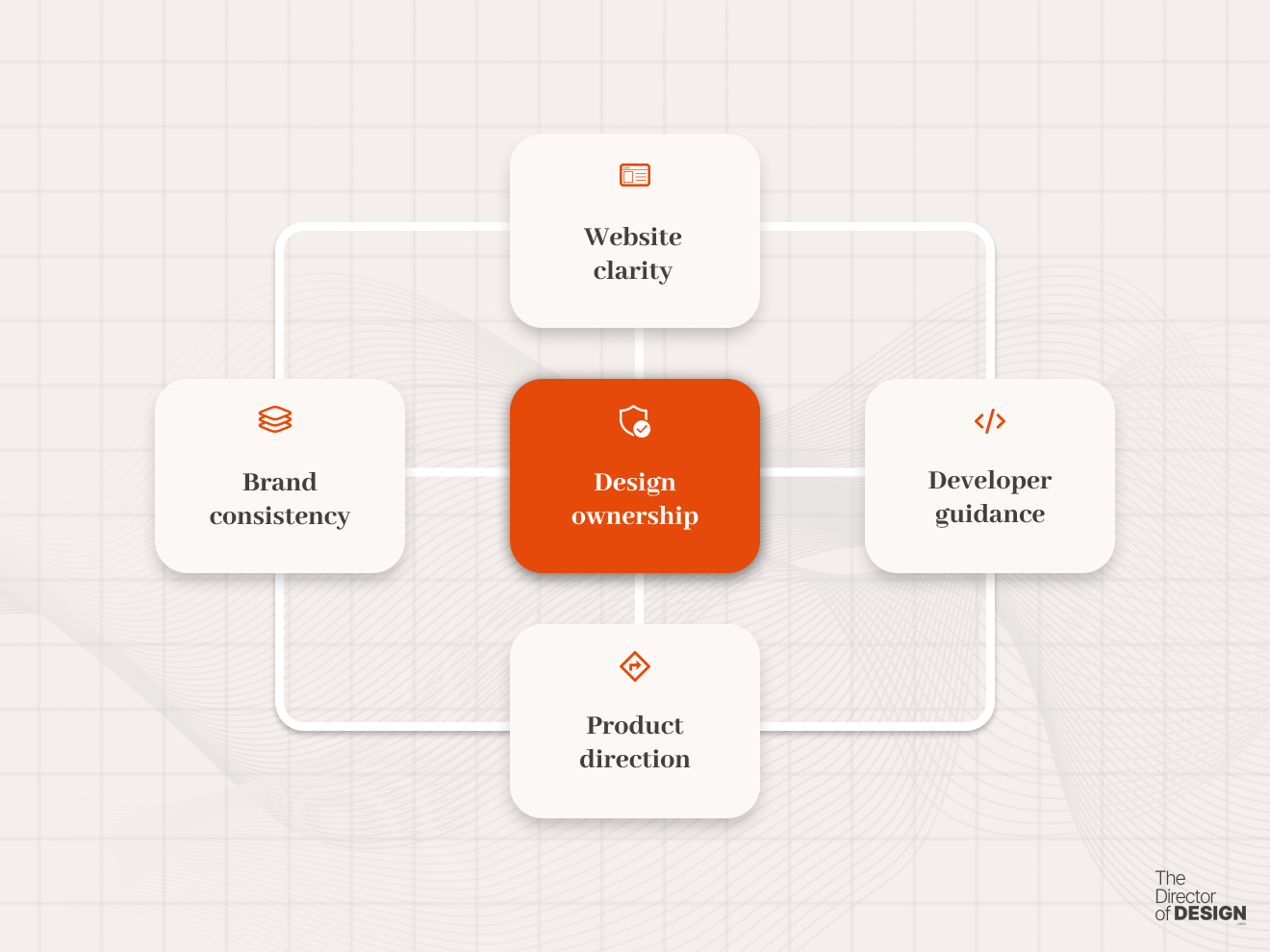
The role connects website clarity, product direction, brand positioning, user experience, design standards, trust, and decision ownership. It is not only about how things look. It is about how the business is understood, how people move through the experience, and how teams make decisions without waiting for one person to approve everything.
That matters because many founder led businesses do not slow down because they lack talented people. They slow down because the standard, direction, and ownership behind design decisions were never made clear enough for the team to protect.
The simple answer
A Director of Design leads the decisions behind design work. The role gives direction to the website, product, brand, user experience, content, design standards, and the way design decisions move through the business.
A designer may create the page, screen, campaign, identity, flow, or interface. A Director of Design helps decide what the work needs to achieve, what should be protected, what needs to be clearer, and how the final experience should support the business.
The difference is important. A business can have good designers and still struggle if the design direction is unclear. Good execution needs good judgement before it. That is where design leadership matters.
What a Director of Design does inside a growing business
Inside a growing business, a Director of Design helps turn scattered design activity into clearer direction. That can include the website, product experience, service presentation, brand perception, content structure, user journey, sales experience, and team feedback process.
- Clarifies what the website, product, brand, or experience needs to communicate.
- Creates standards that reduce subjective feedback and repeated rework.
- Helps founders and leadership teams decide what matters before execution begins.
- Connects design decisions to trust, positioning, conversion confidence, and user clarity.
- Improves decision ownership so capable people can move without waiting.
- Looks across website, product, brand, user experience, and business direction as one connected system.
The role is valuable because design problems rarely stay inside design. A weak homepage can create sales friction. A confusing product experience can damage trust. A drifting brand can weaken premium perception. Unclear standards can turn every review into a personal opinion.
A Director of Design is not just a senior designer
A senior designer often solves complex design tasks. A Director of Design helps the business decide which problems are worth solving, what direction the work should follow, and how the design standard should be protected across different teams and touchpoints.
This is why the role is especially useful when a business already has designers, developers, marketers, freelancers, or agencies, but the work still feels disconnected. The issue may not be effort. The issue may be missing leadership around the decisions behind the effort.
- What should this communicate?
- What should the buyer understand faster?
- What needs to feel more trustworthy?
- What is creating hesitation before contact?
- What standard should the work meet?
- Who owns the final decision?
When those questions are unanswered, design becomes slower and more emotional than it needs to be. When those questions are clear, the work becomes easier to judge, easier to improve, and easier for the team to move forward with.
Why founders often need design leadership before they realise it
Many founders protect the business by staying close to the work. They approve the website. They shape the product. They guide the brand. They comment on the messaging. They protect the standard because the business still carries their judgement.
Early on, this can be a strength. It keeps the business close to the founder vision. It prevents careless decisions. It protects quality when the team is small.
As the business grows, the same pattern can become a bottleneck. The founder becomes the approval system. Work returns for more feedback. Projects wait for sign off. The team becomes careful instead of confident.
This is not always a design problem. It is often a leadership gap showing up through design. A Director of Design helps turn founder judgement into direction that the team can actually use.
Website, product, brand, and user experience decisions
A Director of Design looks at the places where design affects trust, understanding, and momentum.
On a website, that may mean clarifying the offer, improving the page structure, reducing confusion, strengthening trust signals, and making the business easier to understand before a buyer makes contact.
In a product, it may mean simplifying journeys, improving user confidence, sharpening information hierarchy, reducing friction, and making the experience feel more deliberate.
In a brand, it may mean creating stronger consistency, clearer positioning, better premium perception, and a more reliable sense of what the business stands for.
Across the team, it may mean setting clearer standards so feedback becomes less personal and decisions become easier to explain.
Design standards reduce personal opinions
When a business has no clear design standard, every review becomes more personal than it needs to be. One person likes it. Another does not. The founder has a feeling. The team tries another direction. The same work returns again.
Clear standards change the conversation. Instead of asking whether someone likes the work, the team can ask whether the work supports the right outcome.
- Does it make the offer clearer?
- Does it improve trust?
- Does it reduce friction?
- Does it feel consistent with the business?
- Does it help the user make the next decision?
- Does it protect the standard the business wants to be known for?
That is why standards matter. They do not kill creativity. They protect direction.
Decision ownership helps teams move
Good teams slow down when ownership is unclear. They do not always slow down because they lack ability. They slow down because they are trying not to make the wrong decision.
If nobody knows who decides, what standard matters, or what the work needs to protect, people wait. They ask more questions. They send work back to the founder. They become careful.
A Director of Design helps make ownership visible. The aim is not to remove founder judgement. The aim is to turn that judgement into direction the whole business can use.
Director of Design, Fractional Design Director, and Director of Design Consultant
A full time Director of Design is usually a senior internal leadership role. That person may manage design teams, set standards, guide product and brand direction, work with leadership, and make sure design decisions support the business.
A Fractional Design Director brings similar senior judgement, but without the business needing a full time hire immediately. This can suit founders who need leadership, standards, and decision clarity before building a permanent senior design function.
A Director of Design Consultant can work through audits, strategic reviews, advisory support, positioning, design direction, and focused leadership around a specific business problem.
The names are different, but the value is similar: clearer judgement, stronger standards, better ownership, and fewer decisions trapped inside one person's head.
When should a business bring in design leadership?
A business should consider design leadership when design decisions start creating friction, delay, or uncertainty.
- The website looks active but still does not feel clear.
- The product is useful but difficult to explain.
- The brand looks polished but does not feel trusted enough.
- Feedback keeps looping through too many opinions.
- The founder still needs to approve every important design decision.
- The team produces work, but the direction keeps changing.
- The business has invested in design, but the experience still feels fragmented.
These are usually signs that the business does not only need more output. It needs better design leadership.
What changes when the role is done well?
When design leadership is working, the business feels calmer. Decisions have a clearer reason behind them. Feedback becomes more useful. The founder does not need to sit inside every detail to protect quality. The team understands what matters and why.
- The website becomes easier to understand.
- The product becomes easier to explain.
- The brand becomes more consistent and deliberate.
- Feedback becomes less personal.
- Design decisions become easier to defend.
- Rework reduces because the standard is clearer before execution begins.
- People move with more confidence because ownership is understood.
That is the real value. A Director of Design does not simply make the business look better. The role helps the business make better decisions that become visible through design.
How The Director of Design helps founder led businesses
The Director of Design works with founders and leadership teams that need senior design judgement across website, product, brand, user experience, trust, positioning, and decision ownership.
The work can begin with a focused video call, a Business Design Audit, or a strategic review of the current website, product, brand, and decision flow.
The aim is to find where clarity is missing, where trust is being weakened, where standards are unclear, and where better ownership could help the business move faster.
Frequently asked questions
What does a Director of Design do?
A Director of Design leads the decisions behind design work. The role helps a business create clearer standards, stronger direction, better user experience, website clarity, product direction, brand consistency, and decision ownership.
Is a Director of Design the same as a designer?
No. A designer usually creates the work. A Director of Design shapes the decisions behind the work, including priorities, standards, ownership, positioning, user experience, and how design supports the business.
When does a founder need a Director of Design?
A founder may need a Director of Design when important website, product, brand, or user experience decisions keep returning to one person, feedback keeps looping, standards are unclear, or the team cannot move confidently without founder approval.
Can a Director of Design work fractionally?
Yes. A Fractional Design Director gives a business senior design leadership without needing a full time hire immediately. This can help founders improve standards, decision ownership, website clarity, product direction, brand trust, and team confidence.
What does The Director of Design help with?
The Director of Design helps founder led businesses and leadership teams create clearer design decisions across website, product, brand, user experience, trust, standards, decision ownership, and premium perception.
Final thought
A business does not need every design decision to become louder. It needs the right decisions to become clearer.
That is what a Director of Design helps with. The role turns design judgement into standards, ownership, trust, direction, and business clarity that the whole team can use.
Related pages